
Baccarat Card Values

If you want to understand baccarat, the first thing you must learn is how card values work. Baccarat looks like a card game you may already know, but the way cards are counted is different. Once you understand card values and hand totals, the rest of the game becomes very easy to follow.
Card Values in Baccarat
Baccarat card values define how each card contributes to the final hand total. These values decide which side wins every round. In baccarat, cards always have fixed values, and the same rules apply to both the Player and the Banker. Suits, colors, and card order never matter.
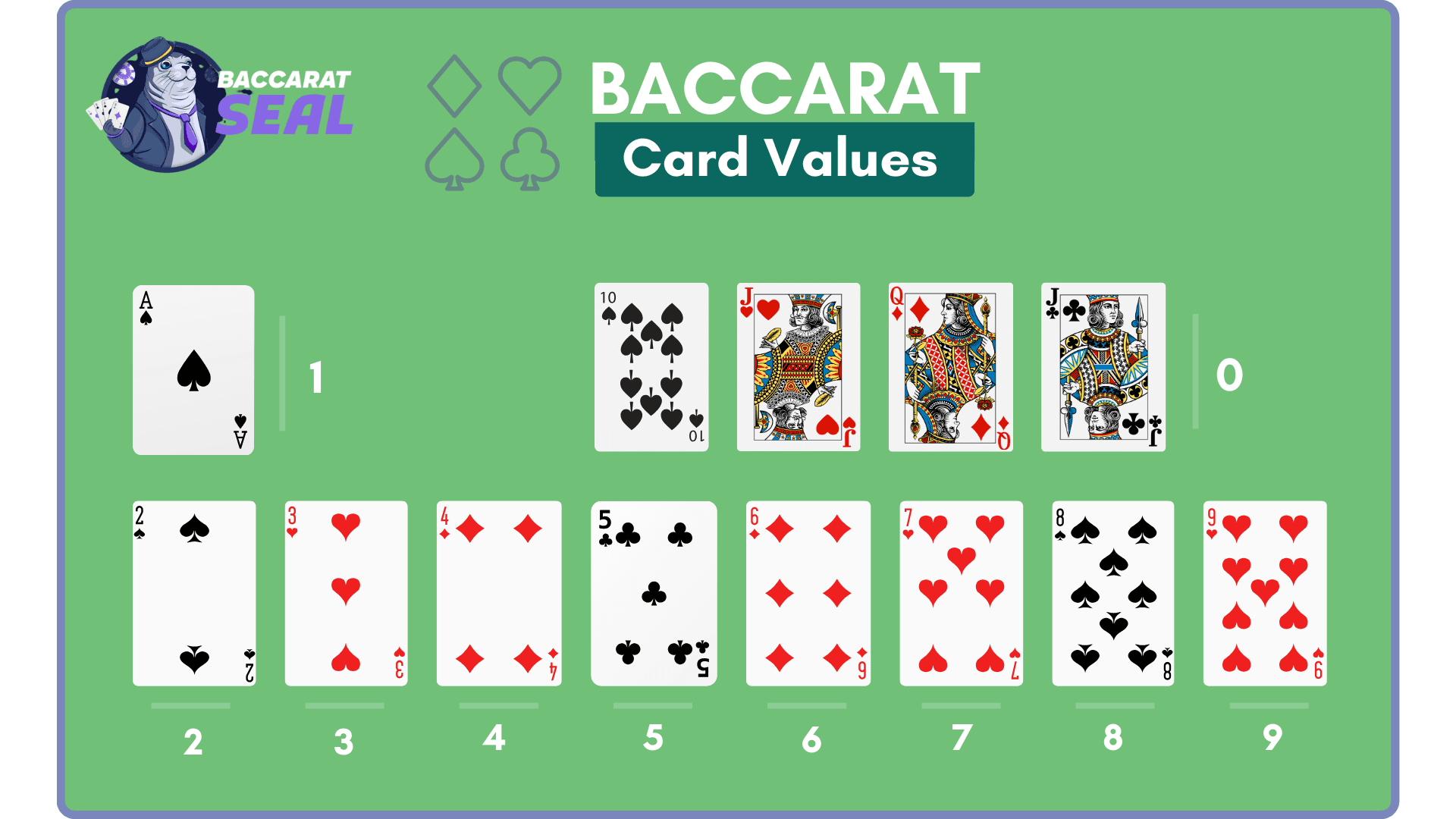
In baccarat, cards do not follow their usual face value in all cases. Number cards are counted normally, but tens and face cards have no value at all.
An Ace is worth 1 point. Cards from 2–9 are worth their face value. 10, Jack, Queen, and King are all worth 0. This rule applies to both the Player and the Banker. There is no difference between sides when it comes to card values.
Because so many cards count as 0, baccarat hands often look confusing at first. However, this is exactly what makes the game simple once you get used to it.
How Baccarat Hand Values Are Calculated
To calculate a baccarat hand, you add the values of the cards together. If the total is 9 or less, that number is the hand value. If the total is higher than 9, you drop the first digit and keep only the last one.
For example, if the cards add up to 12, the hand value is 2. If they add up to 15, the hand value is 5. Baccarat hand values are always between 0–9. There is no such thing as going over or busting in baccarat.
This 1-digit rule is the most important thing to remember when reading a baccarat table.
Two-Card and Natural Hands
Every baccarat round starts with 2 cards for the Player and 2 cards for the Banker. Sometimes, these 2 cards are enough to finish the round.
If either side has a total of 8 or 9 with the first 2 cards, this is called a natural. A natural hand ends the round immediately, and no more cards are drawn. A natural 9 is the best possible hand in baccarat, followed by a natural 8.
When a natural appears, the winner is decided right away, which is why these hands are so important.
Three-Card Hands
If neither side has a natural, a 3rd card may be drawn. Whether a 3rd card is taken depends on fixed baccarat rules, not player decisions.
When a 3rd card is added, it is simply included in the total like any other card. The same 1-digit rule still applies. Even with 3 cards, the highest possible hand value remains 9.
The 3rd card does not change how values are counted, only the final total.
Player, Banker, and Tie Outcomes
Once both hands are complete, the values are compared. The hand with the higher final value wins the round. If the Player has a higher number, Player wins. If the Banker has a higher number, Banker wins.
If both hands finish with the same value, the result is a Tie. Suits, card order, and colors do not matter at all. Only the final number decides the outcome.
Common Baccarat Card Value Mistakes
The most common mistake beginners make is counting face cards as 10. In baccarat, all face cards and tens are worth 0. Forgetting this leads to constant confusion.
Another common mistake is forgetting to drop the first digit when the total is above 9. Baccarat always uses 1-digit hand values, no matter how many cards are in the hand.
Once you stop thinking in blackjack or poker terms, these mistakes disappear quickly.


